
Western Australia Grower’s Guide
Santalum acuminatum (Desert Peach, Quandong) and Santalum spicatum (WA Sandalwood)
A guide for growing, troubleshooting and quick-start (planting) checklist
This guide compiles practical, research-backed steps for establishing and maintaining Quandong and Sandalwood in Western Australia’s arid and semi-arid conditions.
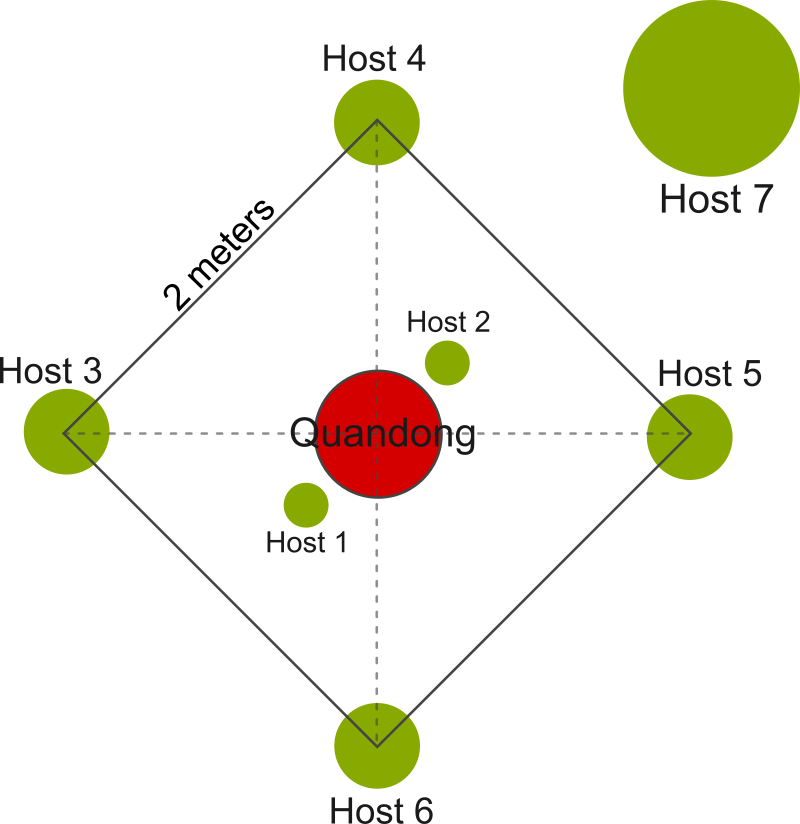
Diagram: Example Planting Layout showing a central Quandong with multiple hosts for redundancy, distance varying from host based on size and age e.g. Saltbush > Acacia
2. Climate & Site Selection (WA)
4. Host Plants & Establishment
10. Troubleshooting – Common Issues (WA)
11. Quick-Start Checklist (WA)
12. References & Further Reading
1. Understanding the Plant
Santalum belongs to Santalacea family of plants a lineage of hemi-parasitic (forms haustoria to draw water and nutrients from nearby hosts) shrubs and trees.
1.1 Santalum acuminatum
- Once established drought-tolerant shrub/small tree (2 – 6 m).
- Native to semi-arid areas of Western Australia, South Australia and NSW
- Fruit: bright red drupes (15 – 25 mm) with tart flesh; kernel inside a hard nut.
1.2 Santalum spicatum
- Native to semi-arid areas of Western Australia and South Australia
- Small shrubby tree grows 2-6m
- Orange fruit 30mm in diameter, edible nut.
- Oil harvested from wood and nuts
2. Climate & Site Selection (WA)
- Best suited to inland/arid/semi-arid zones; young plants are frost-sensitive.
- Sunlight: at least 6 – 8 hours/day; select open locations sheltered from cold winds.
- Spacing: quandongs 3 – 5 m apart; hosts positioned 0.1 – 2 m from each plant.
- Both species are desired for tolerance of West Australian conditions.
3. Soil Requirements
- Well-drained sandy or loamy soil; avoid heavy clay and water-logging.
- Target pH: 6.0 – 7.5. Improve drainage with coarse sand/perlite and organic matter.
- Annual soil testing recommended; raise beds where drainage is marginal.
4. Host Plants & Establishment
- Preferred hosts: Acacia spp., Casuarina spp., Old Man Saltbush (Atriplex nummularia), native grasses, legumes
- Plant multiple hosts per tree to reduce reliance on any single host.
- Manage competition: prune hosts lightly and avoid aggressive species that out compete seedlings.
5. Planting & Mulching
- Recommended time for planting seedlings is between March-September (All year if in pots)
- Plant in full-sun to part shade
- Protect from winds and frost while establishing
- Mulch (straw/wood chips) to suppress weeds and moderate soil moisture; keep mulch clear of stem base.
6. Watering
- Young plants: regular watering until established; avoid saturated soils.
- Mature plants: drought-tolerant; irrigate during prolonged dry spells only.
7. Fertilization
- Use low-phosphorus native-safe fertilizers or balanced slow-release (apply spring and summer).
- Organic options: compost, well-rotted manure, fish emulsion; avoid over-fertilizing.
- Monitor deficiencies: yellowing (N), poor fruit set (P), weak growth (K).
8. Pests & Diseases
- Quandong moth (Paraepermenia santaliella), is the most significant insect pest. Minor pests include aphids, scale insects, spidermites, mealybugs; inspect regularly.
- Controls: neem oil, insecticidal soap; encourage beneficials (ladybirds).
- Disease risks: root rot in poorly drained soils; reduce humidity and improve airflow.
9. Harvesting & Use
- Fruit after 3 – 4 years under good conditions; ripens late spring to early summer.
- Sandalwood can be harvested for multiple purposes reference information.
- Use fresh, dried, or processed (jams, sauces, pies); kernels have traditional uses.
- Quandongs are ornamentally used in landscaping and desired for longevity.
10. Troubleshooting – Common Issues (WA)
Problem Likely Cause; Action
- Yellow leaves Nitrogen deficiency; weak host connection Apply native-safe fertilizer; check host health/proximity; add mulch.
- Stunted growth Inadequate host; poor drainage Add/prune hosts; amend soil with sand/perlite; use raised beds; wind protection.
- Root rot Water-logging/heavy clay Improve drainage; reduce irrigation; plant on mounds.
- Pests (moths/aphids/scale/mites) Sapsucking insects Neem/insecticidal soap; encourage beneficials; prune affected tips.
- Poor fruit set Limited pollination; nutrient imbalance Plant multiple trees; increase K during flowering; avoid excessive N.
- Host dominance Aggressive host competition Prune host canopy/roots; maintain 1 – 2 m spacing.
- Frost damage (young) Cold snaps Use frost cloth; choose sheltered micro-sites.
11. Quick-Start Checklist (WA)
- Select full-sun site (4 – 8 h/day); sandy/loamy soil, pH 6.0–7.5.
- Prepare soil with compost + coarse sand/perlite if required (well draining native ground); remove weeds, mounding can be used.
- Choose hosts; plant smaller shrubs 0.1–2 m from quandong/sandalwood depending on host root system.
- Clover or grass can be used as a close permanant or temporary host. Do not disturb root systems, hosts can be culled when larger established.
- Space larger trees 3 – 10 m.
- Water regularly until established; avoid waterlogging.
- Protect from winds.
- Fertilize lightly in spring/summer with native-safe products.
- Monitor pests monthly; treat early with neem/insecticidal soap.
- Expect first harvest ~3 – 4 years; pick red fruit late spring–summer.
12. References & Further Reading
- ANBG Growing Native Plants – Santalum acuminatum: https://www.anbg.gov.au/gnp/interns-2002/santalum-acuminatum.html
- ANPSA – Propagation of the Quandong (Ben Lethbridge): https://anpsa.org.au/APOL7/sep97-2.html
- Atlas of Living Australia Santalum spicatum: https://bie.ala.org.au/species/https://id.biodiversity.org.au/node/apni/2907960
- Australian Native Plant Society (Australia) Santalum acuminatum: https://anpsa.org.au/plant_profiles/santalum-acuminatum/
- Australian Sandalwood network: http:www.sandalwood.org.au
- Department of environment and water: https://spapps.environment.sa.gov.au/seedsofsa/speciesinformation.html?rid=79
- Plantiary – Santalum acuminatum overview: https://plantiary.com/plant/santalum-acuminatum_52048.html
- PIRSA Fact Sheet – Quandong production: https://www.ausbushfoods.com/bushfoodsonline/reports/Fact%20Sheets/pirsaquandong.pdf
- Prolific or precarious: a review of the status of Australian sandalwood (Santalum spicatum [R.Br.] A.DC., Santalaceae), The Rangeland Journal Vol. 43 issue 4: https://connectsci.au/rj/article/43/4/211/73333/Prolific-or-precarious-a-review-of-the-status-of